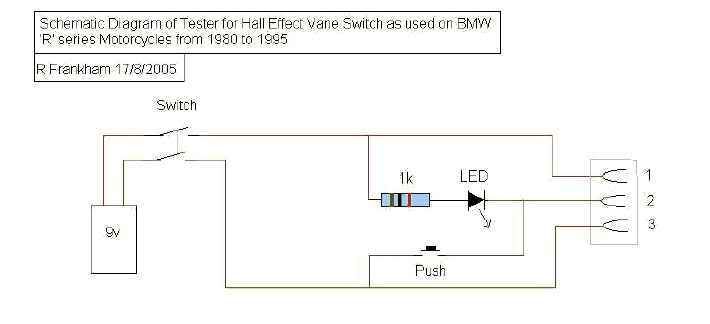
Oops, I didn't notice that you indicated "12V LED" in the schematic - this IS important as using a regular LED (0.7V) in its place will cause a problem.
I don't know if many will know or easily find the difference between them. The following schematic will also work and uses very readily found parts.
The 1K Ohm resistor should be in SERIES with the LED, not in parallel with it. Otherwise, you DO risk damage to the Hall Effect sensor since the LED will only have about 0.65V across it and will not limit the current through the sensor. That is what the 1K resistor is for.
Here is a diagram for a tester which is credited to R Frankham. It is handy in that the extra push button switch enables one to "test" the tester, so if pushing the button does NOT cause the LED to light, the battery is no good. Otherwise, one would not use the little push button switch to test the Hall Effect sensor.
Testing is as simple as connecting it up to the connector and turning on the power switch to the 9V battery and turning the sensor (with or without motorcycle engine attached). The LED should come on when the vane alignment cause the magnet in the bean can to trip the sensor, which should be near TDC.
Do NOT have your ignition turned on (Safest to disconnect the motorcycle battery !) when doing this test.